(This is a demo article for Testing)
The Sanskrit linguistic tradition represents one of humanity's most sophisticated early achievements in the systematic study of language. Emerging over two millennia ago in ancient India, this tradition developed analytical frameworks so precise and comprehensive that they continue to influence modern linguistics, computational language processing, and our understanding of how language works.
The Genesis of Sanskrit Grammar
The story of Sanskrit linguistics begins with a profound practical need: preserving the sacred Vedic texts with absolute accuracy. The Vedas, composed in archaic Sanskrit between 1500-500 BCE, were transmitted orally across generations. Even the slightest mispronunciation or variation in tone could, according to Vedic tradition, alter the efficacy of religious rituals. This religious imperative drove the development of an extraordinarily detailed science of language.
What emerged was not merely a set of religious rules, but a systematic, scientific approach to understanding language structure that would make Sanskrit grammarians the world's first true linguists.
Pāṇini: The Master Architect
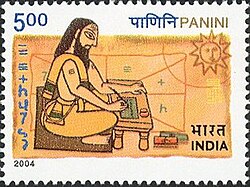
No discussion of Sanskrit linguistics is complete without Pāṇini, whose Aṣṭādhyāyī (Eight Chapters), composed around the 4th century BCE, stands as perhaps the most remarkable linguistic work ever produced. This text of approximately 4,000 aphoristic rules (sūtras) describes the entirety of Sanskrit grammar with breathtaking economy and mathematical precision.
Pāṇini's achievement is staggering. His grammar is:
Generative: It doesn't simply list words or forms but provides rules that can generate all grammatically correct sentences in Sanskrit from basic roots and affixes.
Algorithmic: The rules function like a computer program, applying in a specific order with explicit instructions about when each rule operates and when it's blocked by others.
Metalinguistic: Pāṇini invented sophisticated metalinguistic notation, using technical terms and symbols to describe language itself—a meta-language to analyze language.
To appreciate the sophistication, consider that Pāṇini's grammar employs concepts remarkably similar to modern formal language theory. He uses what we would now call recursion, transformation rules, and context-sensitive operations. The linguist Leonard Bloomfield called the Aṣṭādhyāyī "one of the greatest monuments of human intelligence," while others have noted its similarity to modern computer programming languages—millennia before computers existed.
The Commentarial Tradition
Pāṇini's work, while complete, was so compressed that it required interpretation. This gave rise to a rich commentarial tradition:
Kātyāyana (3rd century BCE) composed the Vārttika, critical annotations that discussed exceptions, refinements, and alternative interpretations of Pāṇini's rules.
Patañjali (2nd century BCE) wrote the Mahābhāṣya (Great Commentary), a masterwork of linguistic philosophy that not only explained Pāṇini and Kātyāyana but engaged in sophisticated discussions about meaning, language acquisition, the relationship between words and reality, and the nature of linguistic knowledge.
Together, these three—Pāṇini, Kātyāyana, and Patañjali—form what the tradition calls the trimuni (three sages), the foundational pillars of Sanskrit grammatical science.
Phonetics: The Science of Sound
Before grammar came phonetics. The Sanskrit tradition developed an incredibly sophisticated understanding of how speech sounds are produced, categorized, and combined.
The Prātiśākhya texts and later works like the Ṛk-Prātiśākhya classified sounds according to:
- Place of articulation (where in the vocal tract sounds are produced)
- Manner of articulation (how airflow is modified)
- Voicing (whether vocal cords vibrate)
- Aspiration (whether there's a burst of breath)
- Nasalization (whether air flows through the nose)
This phonetic analysis was so accurate that it essentially matches modern phonetic descriptions. The Sanskrit alphabetical arrangement itself (the varṇamālā) reflects this phonetic sophistication, organizing sounds in a scientifically coherent manner from gutturals to labials, from vowels to consonants.
The tradition also developed detailed rules of sandhi (euphonic combination), describing how sounds change when they come into contact with other sounds—a phenomenon now studied in modern phonology.
Semantics and Philosophy of Language
Sanskrit linguists didn't stop at structure; they probed deeply into meaning. Different schools emerged with competing theories:
The Mīmāṃsā school argued that words and their meanings have an eternal, inherent relationship (autpattika), a position somewhat analogous to linguistic nativism.
The Nyāya school held that the word-meaning relationship is conventional (saṅketa), established by social agreement.
The Vyākaraṇa (grammarian) school, particularly the Bhartṛhari tradition, developed sophisticated theories about sphota—the idea that meaning is grasped in a single, indivisible flash of understanding rather than being built up piecemeal from individual sounds or words.
These debates anticipated modern discussions in semantics about compositionality, reference, and the nature of linguistic meaning.
The Eternal Relevance
Why does this ancient tradition matter today?
For Computational Linguistics: Pāṇini's rule-based, algorithmic approach has influenced natural language processing. Researchers have explored using Pāṇinian frameworks for computational Sanskrit analysis and even for understanding human language processing more broadly.
For Linguistic Theory: The generative nature of Pāṇini's grammar anticipated by over two millennia Noam Chomsky's revolutionary work in generative grammar. Both share the insight that language is rule-governed and that a finite set of rules can generate an infinite number of sentences.
For Cognitive Science: The Sanskrit tradition's explorations of how we understand meaning, how we learn language, and how linguistic knowledge relates to other forms of knowledge remain relevant to contemporary cognitive science.
For Cultural Understanding: The tradition demonstrates that sophisticated scientific thinking about language emerged independently in multiple world civilizations, challenging Eurocentric narratives about the history of science.
A Living Tradition
Remarkably, the Sanskrit linguistic tradition is not merely a historical artifact. In traditional pāṭhaśālās (Sanskrit schools) across India, students still memorize Pāṇini's sūtras, study the classical commentaries, and engage with this 2,500-year-old intellectual tradition as a living system of knowledge.
Modern scholars continue to discover new insights in these ancient texts, finding in them sophisticated solutions to linguistic problems and fresh perspectives on perennial questions about language and mind.
Conclusion
The Sanskrit linguistic tradition stands as a testament to human intellectual achievement—a reminder that rigorous, scientific thinking about language flourished long before the modern era. From Pāṇini's algorithmic grammar to the phonetic precision of the Prātiśākhya texts, from sophisticated semantic theories to meta-linguistic innovation, ancient Indian grammarians laid foundations that continue to support linguistic inquiry today.
As we develop ever more sophisticated computational models of language and probe deeper into how the human mind processes linguistic information, we find ourselves walking paths first traced by scholars working by lamplight in ancient India, armed with nothing but keen observation, logical reasoning, and an abiding fascination with the miracle of human language.
Their legacy is not just historical—it's a living invitation to think deeply, systematically, and wonderingly about the most human of all faculties: our capacity for language.